

France’s Enduring Gothic Cathedrals
By Rick Steves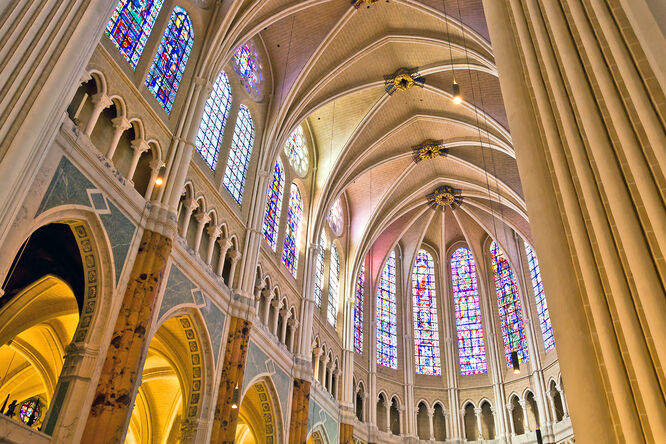
Despite many years of traveling to France, I still can't help but marvel at the towering Gothic churches that mark the heart of many French cities. I like to imagine being a pilgrim 600 years ago, hiking for days to a particular church on a particular holy day — and feeling awe when the soaring spire of the cathedral finally appeared on the distant horizon.
The Gothic style of architecture, primarily employed in churches, evolved in medieval France as a way to give interior spaces a better-lit, more upward-reaching feel than the dark, heavy Romanesque architecture that preceded it. As French urban life grew more stable, churches didn't need to be so fortress-like — and engineering innovations allowed architects to build airier, vertical churches that stretched heavenward, their walls given over to windows to allow more of God's light to shine in. Newly pointed arches allowed churches to grow higher and more dramatic on the outside, while making space for colorful stained-glass windows on the inside. Counterweight "flying" buttresses — stone arches that reach up from the ground to push back inward on relatively weak external walls — can make the interior of giant stone buildings feel almost weightless.
While mostly made of stone, many Gothic churches feature a wooden roof and/or spire, making them susceptible to fires — like the one that overtook Paris' Notre-Dame Cathedral in 2019. Happily, the church has been restored, and visitors can once again take in France's most famous Gothic wonder. But plenty other magnificent Gothic cathedrals are sprinkled across the country, like jeweled pins on a map.
Just over an hour from Paris is Chartres, home of the cathedral that's arguably Europe's best example of pure Gothic. Officially known as the Cathédrale Notre-Dame de Chartres — it's one of more than a hundred churches dedicated to "Our Lady" ("Notre Dame") scattered around France — it too experienced a harrowing fire, burning to the ground in 1194.
Amazingly, Chartres' cathedral took just 30 years to rebuild — astonishing when you consider it took centuries to build other major cathedrals (such as Paris' Notre-Dame). What visitors see now is a unity of architecture, statuary, and stained glass that captures the spirit of the 13th-century "Age of Faith" like no other church.
At the time of Chartres' fire, the church owned the veil supposedly worn by Mary when she gave birth to Jesus, making this small town a major player on the pilgrim circuit. While the veil was feared lost in the fire, it was "found" in the crypt days later, unharmed. This miracle (or marketing ploy) became the impetus to rebuild quickly. You can still view the veil, but for me the highlight of the church is the central window behind the altar: the "Blue Virgin" window. It shows Mary dressed in the famed "Chartres blue," a sumptuous color made by mixing cobalt oxide into the glass.
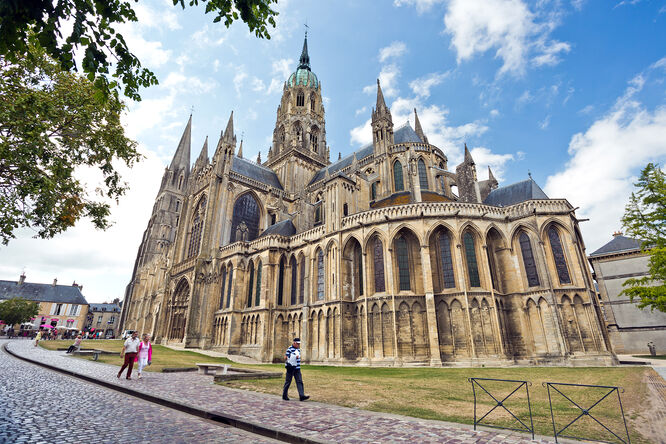
Two of my favorite Gothic cathedrals are just north of Chartres, in neighboring Normandy.
In contrast to small-town Chartres, Rouen was France's second-largest city in medieval times. Its cathedral, also dedicated to Mary, is primarily famous as a landmark of art history: Claude Monet painted 30 different studies of its Flamboyant Gothic (mid-14th century) facade at various seasons and times of day, capturing his "impressions" as the light played across its exquisitely detailed masonry.
The cathedral was constructed between the 12th and 14th centuries, though lightning strikes, an accidental bombing during World War II, and other destructive forces meant constant rebuilding. Inside is a chapel dedicated to Joan of Arc (she was convicted of heresy in Rouen and burned at the stake there in 1431) and several stone tombs from when Rouen was the capital of the dukes of Normandy — including one containing English King Richard the Lionheart's lion-heart.
Two hours west, Bayeux's cathedral — as big as Paris' Notre-Dame — dominates its small town. Its two towers and west facade were originally Romanesque, but the towers were later capped with tall Gothic spires, and the facade embellished with a decorative Gothic "curtain" of architectural details. Historians believe the Bayeux Tapestry, the 70-yard-long embroidery telling the story of William the Conqueror's victory in the Battle of Hastings, originally encircled the nave. (Until fall 2027, the tapestry itself is out of town on a visit to London's British Museum.)
The most impressive Gothic church in eastern France is in Strasbourg, where its venerable cathedral — another "Notre-Dame" — somehow survived the French Revolution, the Franco-Prussian War, and both World Wars. The interior is worth savoring slowly, with its wide nave, exquisite gold-leaf organ, and elaborately carved stone pulpit. The marvelous stained glass, 80 percent of which is original, dates as far back as the 12th century. The exterior, with its red sandstone and cloud-piercing spire (at 466 feet, it was the world's tallest until the mid-1800s), stands out from the other great Gothic churches in France.
Gothic churches have proven resilient, both physically and as powerful works of architectural art. Through wars, fires, and Mother Nature, France's great cathedrals have survived thanks to their ingenuity of design and the loving care of the people they serve.